Cross-posted from my development journal in the Jarela repo .
The first commit is dated 15 May 2026: a repository scaffold and nothing else. Today is 23 November, and the project is at 3.8.0. In between there are 192 days, 1,625 commits, 168 tagged releases, 115 architecture decision records and 599 test files.
I wrote a retrospective at 0.13.0 in June that was mostly about features. This one is about the machinery underneath, and about which parts of it turned out to be true. Some of the lessons I expected. The ones that mattered most, I did not.
The numbers, and what they are not
| Metric | Value |
|---|---|
| Days since first commit | 192 |
| Tagged releases | 168 |
| Commits | 1,625 |
| Text lines added / deleted | 504,222 / 145,979 |
| Net accumulated lines | ~358,000 |
| TypeScript + TSX files | 1,538 |
| Test files | 599 |
| ADRs | 115 |
| Built-in skills | 9 |
| Prompt-evaluation scenarios | 15 |
The line count deserves a caveat before it becomes a headline. It is the running sum of added minus deleted text lines, not a source-only count. It includes blank lines, comments, documentation, tests, fixtures and generated text. The checkout itself is about 351,000 text lines across 1,949 tracked files, which is the smaller and less flattering number. Neither figure is a quality signal. Roughly 146,000 of those lines were deleted, which is the more interesting number: a lot of the work was building something, discovering the shape was wrong, and removing it again.
The direction document I wrote at 3.0 has a section called “evidence boundary” for exactly this reason. The fact that a capability exists in the repository does not prove that it works, that anyone uses it, or that it belongs in core. Six months of changelog is evidence of effort, not evidence of quality.
The journey in four phases
1. Prove the loop (0.1.0 to 0.13.0, 23 May to 4 June)
Jarela started as a local LangGraph GUI on my laptop. In under two weeks the
version went from 0.1.0 to 0.13.0 across thirty releases, and it turned into
something that could hold a conversation with the outside world: a WhatsApp
bridge that could route inbound media to vision-capable agents, document recall
over local folders, watcher tasks that polled a tool and woke the agent only
when the output changed, and a security pass that refused loopback and
cloud-metadata addresses in web_fetch and denied access to credential trees in
the file tools.
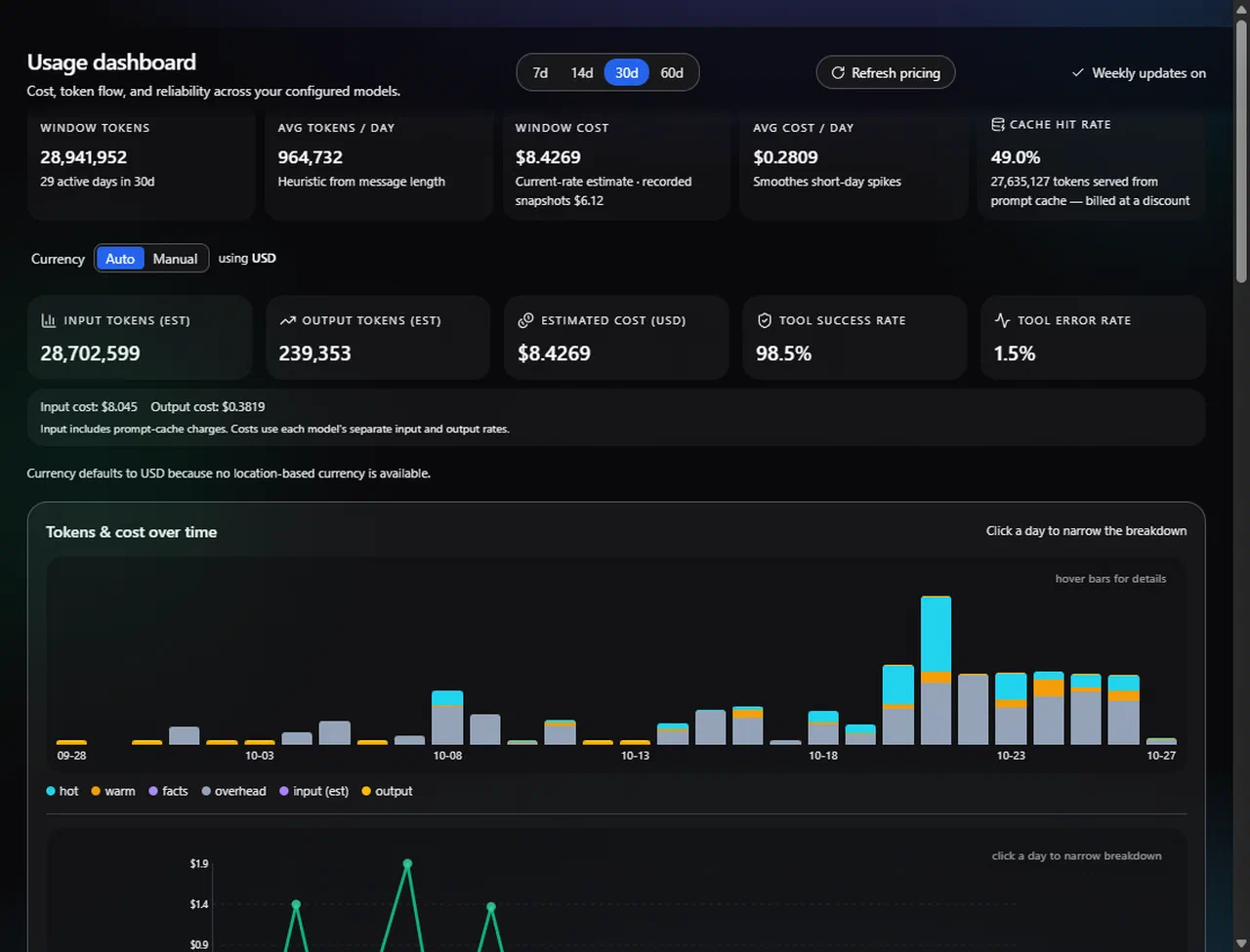
The early lesson was that the model call is the least interesting part of an agent system. Everything that made it usable was around the call: what context went in, which tools were allowed, what happened when a tool failed, and whether I could tell afterwards what it had cost.
2. Become a workspace (1.0.0 to 1.43.2, 6 June to 9 October)
1.0.0 locked the public package surface to five explicit export paths and
turned on Anthropic prompt caching with cache-aware per-turn accounting, because
a multi-step ReAct turn re-sends the same prefix on every step and the bill
shows it.
The rest of the 1.x line was about making the workspace survive contact with reality:
- Context and memory. Image attachments moved out of SQLite rows and onto disk references, then got downscaled at ingest — a phone screenshot went from 4–8 MB to 200–400 KB. Context windows are probed per model and saved, with a halving retry when a provider changes the limit underneath you. Cold recall became structured memory records with summaries and aliases.
- Failure surfaces. Crashed runs write a
run_errorrow that survives a reload. Provider auth failures produce a banner that deep-links to the failing credential. Saving a credential probes the provider first and refuses to save a key the vendor already rejects. - Delegation. Claude Code and Codex became tools, with supervision rather than fire-and-forget.
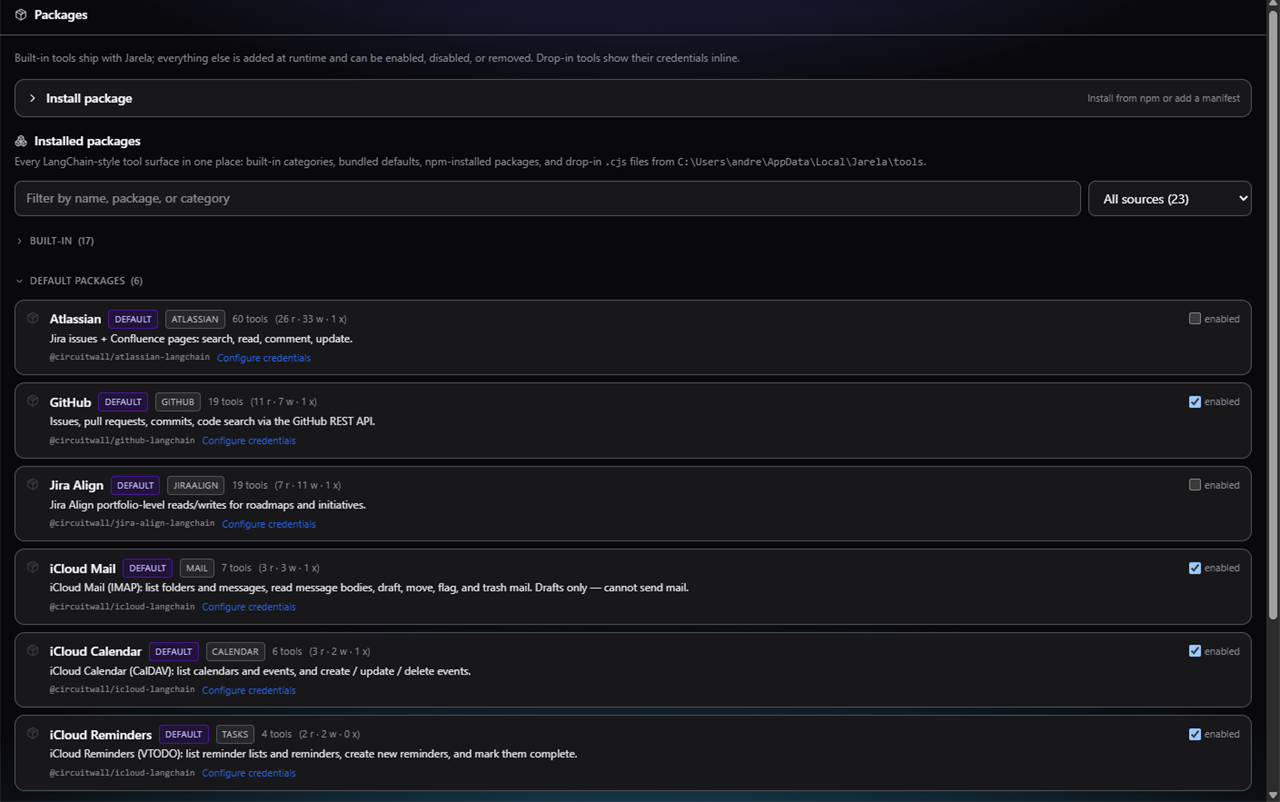
- Packaging and integrations. Portable archives and npm distribution, curated LangChain tool catalogues, MCP discovery, Gmail, Outlook, Atlassian, GitHub, and the eventual removal of two LinkedIn integrations that never earned their maintenance.
1.28.0 is the release I still think about: agents started learning from
repeated workflows, oversized threads started compacting automatically, and tool
failure guidance began steering agents away from repeating the same mistake.
3. Make context durable (2.0.0 to 2.7.0, 11 to 25 October)
2.0.0 was the context release. Context boundaries moved to message sequence
numbers, so a timestamp-only pin could no longer drift; compaction became
topic-aware and shared between the hot-turn and near-budget triggers; submitted
prompts persist before preparation, so a crashed run does not lose the request
that caused it. Agents gained visible workflow checklists whose updates are
verified snapshots rather than prose claims.
The important framing from this phase: context management is state management. Most of the strange behaviour I had been blaming on models was really a stale window, a duplicated message, or a summary that had quietly dropped the one instruction that mattered.
4. Turn features into contracts (3.0.0 to 3.8.0, 27 October to 23 November)
3.0.0 dropped Node 22 and required Node 24.15+ (or Node 26). It also marked a
change in ambition. The direction document behind it (ADR-0111) says Jarela
maintains the workspace and users extend what happens inside it — the core
should get more dependable rather than continuously wider.
That shows up in the code as contracts instead of features:
- Skills and workflows gained explicit execution consent, checksum approval
records, bounded invocation, inert authoring, and a gated runner with a durable
coordinator (
3.1.0–3.3.0). - Dependencies became declared data. A tool can say what it needs, and the
runtime can answer
ready,install_required,manualorunverifiedwithout executing anything during a probe. Two heavy runtimes — local embeddings at roughly 426 MB and the Copilot delegate at roughly 206 MB — moved to on-demand installs, which took a development install from 1,639 MB to 992 MB (3.6.0). - The browser extension was rebuilt around refs resolved in the live page,
batched actions, and a three-layer preflight, after the ledger showed the old
surface failing in structural ways (
3.7.0). - Voice became a pluggable input engine with hands-free capture, replies that
use the same engine family as the input, and speech that starts on the first
complete sentence instead of waiting for the last token (
3.8.0).
What works in an agentic system
Durable state and replayable runs
The single most valuable decision was making the runtime boring and the state durable. Runs are submitted separately from the event subscription, so a dropped socket reconnects to the same run instead of restarting it. Messages have monotonic sequence numbers. Signals have a delivery lease and a transcript transaction. Storage is SQLite with migrations bounded to supported versions.
None of this is agent-specific, which is the point. Every hour spent on durable lifecycle saved several hours of “why did it forget what it was doing”.
Code settles what code can settle
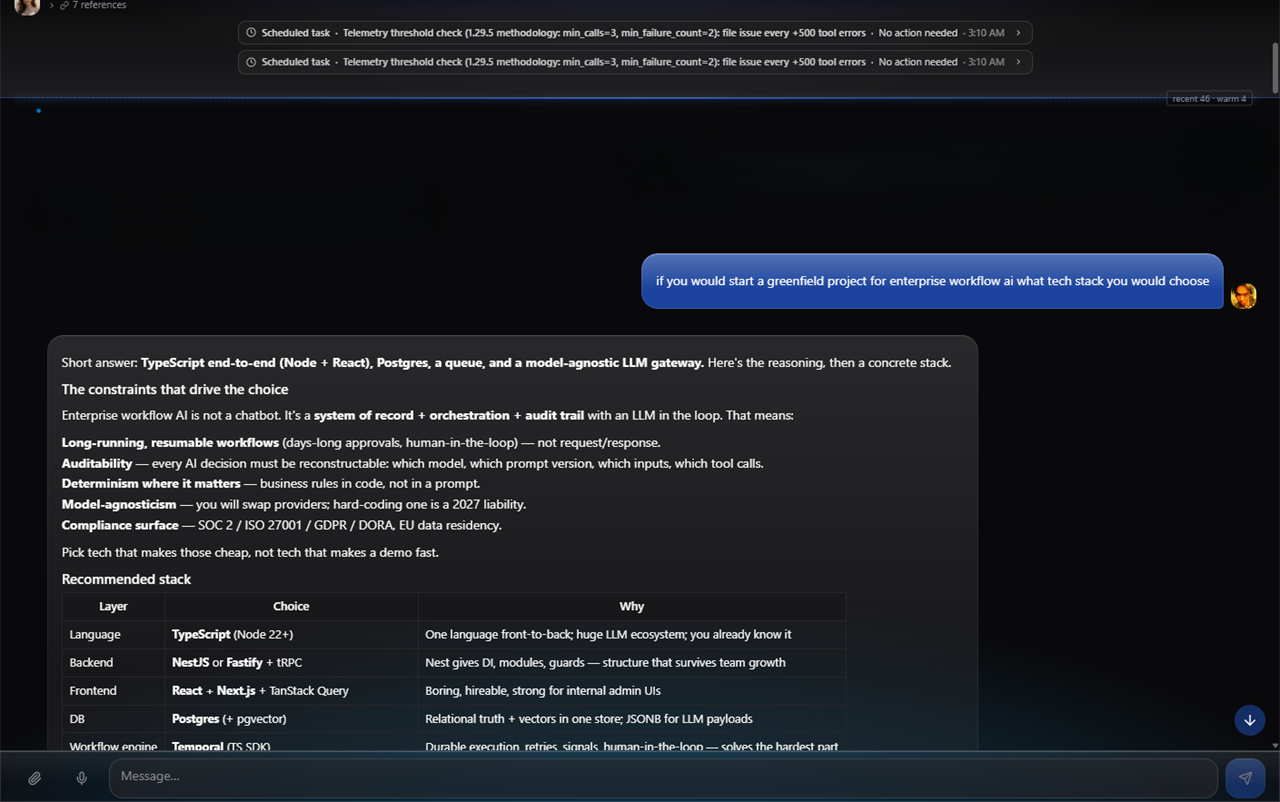
The prompt-evaluation harness is built on one rule: tool selection is never
scored by a model. A scenario declares the expected and forbidden calls, the
arguments are validated against the real tool schema, and scoreToolSelection
decides. The judge only grades what a transcript can show but code cannot settle
— whether the reply was grounded, whether limits were disclosed honestly, whether
the turn ended on a result rather than a promise.
That split matters. A judge that can be argued into a pass is not a gate. There are 15 scenarios and four tiers: assembled-prompt invariants, prompt contracts, a reaction tier that runs the real ReAct loop against fixtures, and an opt-in live tier that spends tokens. The deterministic tiers run on every prompt change. The live tier runs on labelled pull requests and weekly.
Verification at the boundary
Jarela’s output validator checks every assistant turn before the terminal done
chunk leaves the stream. It looks for four fabrication shapes: a claim with no
tool call, a citation of an unregistered tool, a citation of a tool that was
never called, and a summary with no action behind it. It runs on regex, not on
another model, so it costs nothing per turn.
The workflow checklist follows the same idea. A step can only be marked done with input, output and validation fields, and the evidence has to match what the tools actually returned. The agent cannot finish by asserting that it finished.
Narrow context, deliberately
More context is not better context. The system now does the opposite of what most agent demos do:
- Hot history compacts at 50 message rows; idle conversations prompt for compaction after three hours.
- Warm summaries are bounded per agent, and older transcript stays cold and embedding-retrievable rather than inline.
- Recall got a full-text prefilter and a bounded scope, because semantic search over everything is both slow and confidently wrong.
- Prompt caching is placed deliberately: system block, tools block, most recent tool result.
The pattern is to send the smallest thing that can answer the question, and to keep everything else one tool call away.
Capabilities as data
Every built-in tool registers on two axes: a topical category and a safety
capability of read, write or execute. Mixed-capability files declare every
bucket, and an integrationId ties the tool to the integration that backs it, so
an unconfigured integration can deny its tools instead of failing at call time.
External and MCP tools default to execute until a manifest says otherwise.
This is what makes a permission story possible at all. It is also what makes it possible to say “the agent cannot do that” as a fact about the registry rather than a hope about the prompt.
Failures that are visible
The best reliability work in the last three months was not making things work. It was making things fail loudly:
- Watchdog timeouts surface as errors instead of silent hangs, and the idle
watchdog pauses while tool calls are in flight so a long
execdoes not kill its own turn. - Every
fs.*call honours a wall-clock deadline. - The live header says
Sending…,Thinking…,Using <tool>…,Responding…instead of showing an indeterminate bar. - The in-app log panel is filterable, with token redaction built in.
- A stale browser extension is detected by protocol handshake instead of producing a generic timeout.
What does not work
Writing a better prompt
The most expensive misconception I had was that a badly behaved agent needs a better paragraph. The prompt registry now treats prompt text as assembled from roughly twenty builders, with contract tests that check whether a decision is still present and still falsifiable. That catches the text changing. It cannot catch the text being fine while the model ignores it.
The distinction is now explicit in the docs: one failure is a prompt change that no longer carries a decision, caught deterministically; the other is a model that behaves badly anyway, caught only by live evaluation and guardrails. Adding more prose is the wrong fix for the second one, and it took me a while to stop trying.
“Nothing happened” is the default failure mode
Agent systems fail quietly far more often than they fail loudly. The 3.7 and 3.8 changelogs are full of it: silent browser speech failures, speech slices that never start, duplicate evaluation calls reusing a fixture, a stale extension that answered nothing, a retry that ran twice because the first response was ambiguous.
The fixes are unglamorous: idempotency keys, delivery leases, protocol handshakes, explicit terminal states, and treating an absent result as an error rather than an empty success. In an agent loop, silence is indistinguishable from success unless you make it distinguishable.
Fabrication is detected, not prevented
The output validator catches four specific shapes and retries with a nudge. It does not stop a model from inventing a plausible tool result in a shape the regex does not recognise. The anti-hallucination classifier helps, but the honest framing is: this class of failure is managed, not solved, and any claim otherwise would be marketing.
Browser control was genuinely bad
This one deserves numbers, because it is the clearest example of a feature that looked fine in demos and was not fine in use. The local browser command ledger held 48,368 commands between 4 September and 5 November:
| Command | Failure rate | Dominant cause |
|---|---|---|
fill | 67.3% | No element matched |
navigate | 50.1% | Caller timeout, tab crash |
screenshot | 33.3% | Target tab not focused |
snapshot | 6.5% | Tab crash |
click | 5.1% | No match, or timed out before pickup |
The causes were structural, not model behaviour. Selectors went stale between
observation and action. Navigation, dialogs and crashes had no representation,
so they surfaced as timeouts; 5,849 ledger rows were stranded in running with
no terminal state. Screenshots only worked on the focused active tab, which was
the opposite of what the agent was told. And every action was its own model turn,
which is why a workflow with ten DOM steps cost ten round trips even though each
successful command took 17–32 ms.
The rebuild moved resolution into the page, added refs scoped to a document generation, batched actions, and made screenshots model-visible. The lesson is not “browsers are hard”. It is that a demo path and a measured path are different products, and only one of them tells you the failure rate.
Recall is not reading
Semantic recall is excellent at finding the paragraph you half-remember and bad at answering a question that needs the whole document. Adding a full-text prefilter and a bounded scope made it faster and more honest. The remaining limitation is inherent: retrieval gives the model fragments, and the model will happily treat a fragment as the whole.
Approvals are friction, and friction is the point
Every safety feature that works is annoying. Per-host browser grants, one-time approval for host access, execute-tool permissions, consent records for skills, three-layer preflight before a browser step. The temptation is always to smooth the friction away for the demo. The reason not to is that the friction is the security model, and the moment it becomes invisible it stops being a decision.
The extension boundary is a trust boundary, not a sandbox
Installing a package is not the same as trusting its code. External tools and providers load as Node modules, and read/write/execute labels describe intent, not enforcement, for arbitrary code. The admission rule in the 3.0 direction — prefer an extension for a particular user’s task, consider core only when it makes the shared workspace safer or easier to extend — exists because the alternative is a core that absorbs every integration and a trust claim it cannot support.
Evaluations tell you less than they look like they do
The live evaluation tier scores tool selection and answer quality, but it does not execute tools: expected calls receive declared fixtures, and later calls get an explicit stub error. That is the right trade for cost and determinism, but it means the live tier cannot validate side effects. The reaction tier covers those with real tools. Mock mode proves the wiring and nothing else. Fifteen scenarios is a floor, not coverage.
What I would do again
- Build the ledger before the feature. The browser rebuild only happened because the command log already recorded outcome, duration and cause. Without it, the failure would have stayed a vibe.
- Make the model prove it. Citations, verified checklists, output validation, deterministic tool scoring. The model is an unreliable narrator of its own work; design as if that is permanently true.
- Delete aggressively. 146,000 deleted lines against 504,000 added is not waste. It is the cost of finding the right shape, and the project is better for the parts that were removed.
- Keep the runtime boring. Durable state, explicit lifecycle, replayable events. Cleverness belongs in the tools, not in the transport.
- Write the admission rule down. “Does this solve one user’s task, or does it make the shared workspace safer or easier to extend?” is the only reason the feature list has not doubled again.
Where 3.8.0 leaves it
The current release is mostly voice, which is a good place to end a retrospective: it is the newest surface and therefore the one still teaching the old lessons. Hands-free capture pauses on a short silence and sends on a longer one. Replies are spoken by the engine family that produced the input, stream from the first complete sentence, and reopen the microphone afterwards so a conversation can continue without touching the screen. The same release blocks steering the Jarela app tab, keeps unobserved tool results out of the judge input, blocks echoing pasted secrets, and runs prompt-evaluation scenarios concurrently.
Six months in, the shape of the thing is settled: a local-first workspace that maintains state, routes work to agents, keeps context narrow, verifies what can be verified in code, and tries to fail visibly. It is not finished, and the direction document explicitly refuses to declare it finished. But the parts that work are no longer accidents, and the parts that do not are written down.
That is roughly what 360,000 lines buys: fewer mysteries, and a much better list of known problems.
If you want to follow along, the repo is open at github.com/CircuitWall/jarela . It is a personal project — no roadmap, no SLA, no warranty. Just notes from the workshop.