AI in a Large Organization
Rolling out Claude (or any frontier LLM) to one team is easy. Rolling it out to dozens of teams, in a regulated org, on codebases that have been around for a decade, is a different problem. Over the last 3 years leading 40+ engineers across model and product development at Visa, I’ve learned that the bottleneck isn’t the model – it’s the standard tooling, the quality guardrails, and a clear-eyed view of where Claude still falls short on large projects.
Here is what has actually worked.
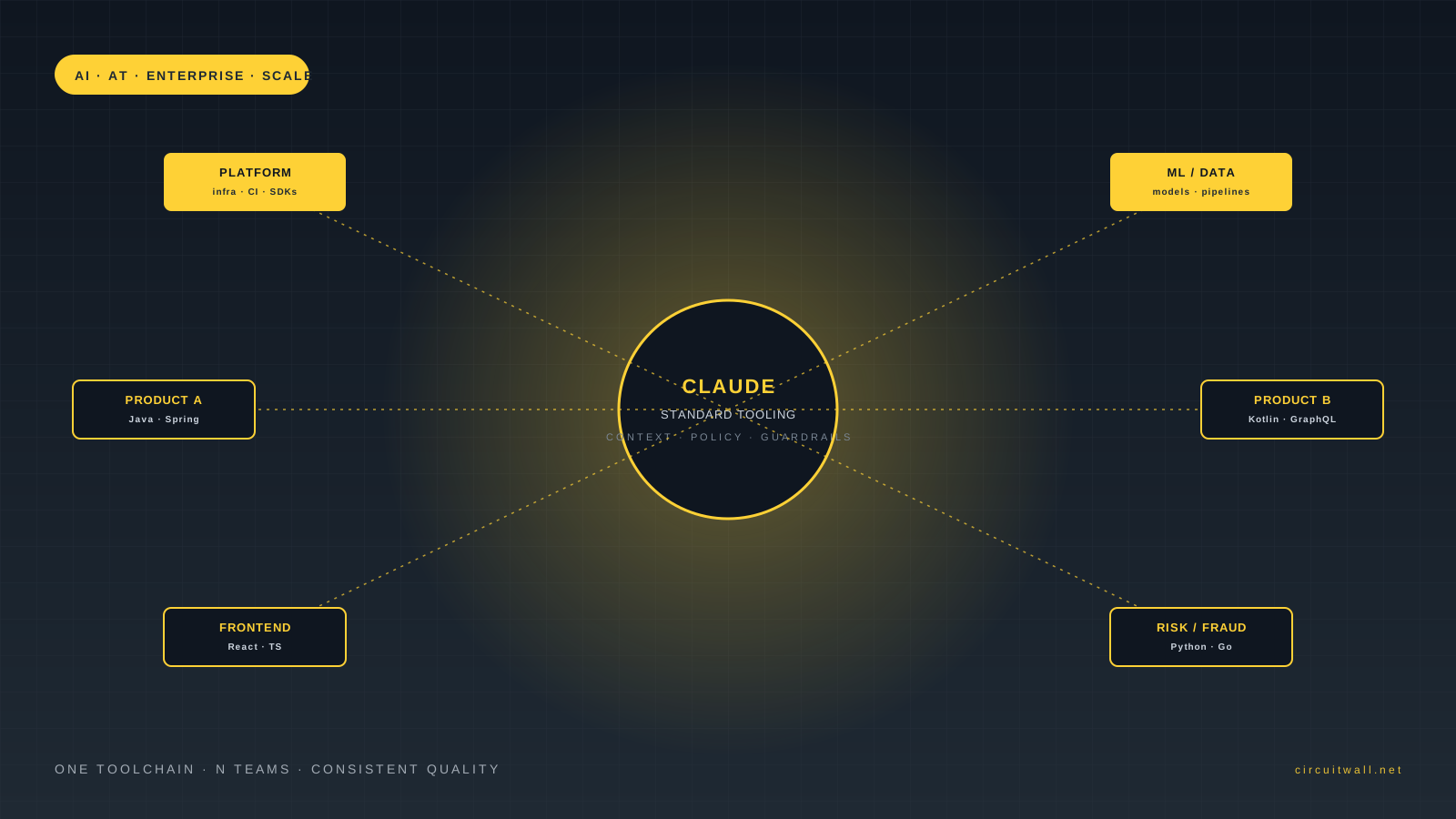
1. Treat AI as a Platform, Not a Per-Team Toy
The first mistake every org makes: each team picks its own AI tool, its own IDE plugin, its own prompt patterns. Six months later you have:
- Six different ways of asking “is this code review-ready?”
- No central place to update a security policy or a coding standard
- Secrets and proprietary code leaked through six different vendors
The fix is to treat AI tooling like any other shared developer surface – CI, package registry, observability – and run it through a platform team.
In practice that means:
- One sanctioned client (e.g. Claude via a managed enterprise gateway) with logging, DLP, and SSO
- One standard
AGENTS.md/CLAUDE.mdtemplate every repo inherits - One internal MCP server fleet exposing the same set of safe tools (issue tracker, code search, deploy status, runbooks) to every team
- One eval harness that scores model outputs against your golden tasks before you change models or prompts
This is the same pattern as having a single CI system instead of every team running their own Jenkins. Boring, but it’s what makes the next two sections possible.
2. Standard Tooling: What “One Toolchain, N Teams” Actually Looks Like
Here is the layering I push for in any org of more than a handful of teams:
2a. Repo-level: AGENTS.md as the contract
Every repo gets an AGENTS.md (or CLAUDE.md) that captures:
- The build / test / lint commands an agent must use, not guess
- Hot files the agent should always read first (architecture notes, public APIs)
- Hands-off zones (generated code, vendored deps, audit-trail directories)
- The definition of done: tests pass, lint clean, security scan clean, docs updated
This file is the single source of truth for both humans and agents. When something goes wrong, you fix it in one place and every team benefits.
But AGENTS.md alone is not enough. It tells the agent how to operate, not what the system is. For that, you need layered documentation – and you need to make Claude take it seriously.
2b. Beyond AGENTS.md: Layered Documentation the Agent Must Respect
The single biggest quality lever I have found is forcing the agent to consult the right level of documentation for the change at hand, in this order:
- System / domain level – “what is this product, who uses it, what guarantees does it provide?”
- Architecture level (HLD) – bounded contexts, services, data flows, sync vs async, public contracts
- Framework / module level – the in-house framework, its lifecycle, its extension points
- Class / API level – the actual symbol, its contract, its invariants, its tests
Skip a level and Claude will write code that compiles and passes tests but quietly violates the design. This is the single most common source of “AI rot” in large codebases.
The doc tree
I keep documentation co-located with code, in a predictable shape:
repo-root/
  AGENTS.md                    # how to operate (commands, gates)
  docs/
    SYSTEM.md                  # what this product is, who pays for it, SLAs
    ARCHITECTURE.md            # HLD: services, contexts, contracts, ADRs index
    adr/                       # one file per architecture decision
      0001-event-sourcing.md
      0002-no-cross-domain-imports.md
  src/
    payments/
      FRAMEWORK.md             # how this module's framework works
      MODULE.md                # public API, extension points, invariants
      Ledger.java
      Ledger.md                # class-level contract, invariants, gotchas
Each level answers a different question and none of them substitutes for the next.
How to make Claude actually read them
Telling the agent “respect the architecture” in AGENTS.md does almost nothing. What works is a mandatory, ordered reading protocol encoded as instructions plus tooling:
In AGENTS.md (the operational contract):
Before writing or modifying code, you MUST:

1. Read docs/SYSTEM.md and docs/ARCHITECTURE.md (cached for the session).
2. For every file you intend to touch, read the nearest FRAMEWORK.md
   and MODULE.md upward in the tree.
3. For every public symbol you change, read the matching <Symbol>.md
   and the closest test file.
4. If any doc contradicts your plan, stop and ask. Do not "fix" the doc
   to match your code.
5. If a required doc is missing, propose one and wait for approval
   before generating code.

Skipping a step is a bug, not a shortcut.
Then back it with tools and gates, because instructions alone drift:
- A
docs.read(level, path)MCP tool that returns the right doc for a given file path and logs which docs were consulted before each edit. PRs without a complete read trail get flagged. - A
find-related-docs(symbol)tool that walks up from a class or function to all governing docs (class -> module -> framework -> architecture -> system). - A pre-commit check that fails the change if a touched public symbol has no class-level doc, or if an ADR-controlled boundary was crossed without a new ADR.
- An eval task per repo: “given this ticket, list the docs you would read in order” – scored against the reviewers’ answer.
High-level design (HLD): the layer Claude is worst at
Claude is strong at class-level work and weak at HLD. Help it:
- Keep
ARCHITECTURE.mdshort and authoritative – one diagram, the bounded contexts, the public contracts, the must-not-cross lines. If it’s 80 pages, the agent will skim it the way a junior would. - Index every ADR with one-line summaries (
adr/INDEX.md) so the agent can grep before it commits. Use ADR status (accepted,superseded) and have the tool refuse to cite superseded ADRs. - Encode the rules the HLD implies as architecture fitness functions (see section 3d). The doc says it; the build enforces it. The agent learns by failing the build, not by being polite.
Framework-level: respect the spine of your codebase
Most large orgs have one or two in-house frameworks (an app skeleton, a service template, a UI shell). Claude has never seen them. By default it will:
- Reinvent your DI container with raw Spring
- Ignore your lifecycle hooks and write
main()directly - Bypass your standard logging / metrics / auth filters
- Use the public version of an API when an internal wrapper exists
The fix is a FRAMEWORK.md per framework that the agent must read whenever a touched file imports from it. Cover:
- The lifecycle (init, request, shutdown) and where extension points live
- The required base classes / annotations / decorators
- Idiomatic patterns vs. anti-patterns, with a one-line why for each
- The escape hatches and when they are acceptable
- A “minimal correct example” the agent can pattern-match against
Pair it with a framework.scaffold(kind) tool that produces the canonical skeleton for a new component. When the agent has a tool that yields the right answer in one call, it stops free-styling.
Class / API level: contracts beat comments
At the symbol level, the highest leverage doc is a short contract block next to the class:
- Purpose in one sentence
- Invariants (what is always true)
- Pre- and post-conditions of public methods
- Thread-safety / re-entrancy notes
- Failure modes and what callers must handle
- Pointer to the canonical test file
This is the doc Claude is best at consuming because it maps directly to code. Make it cheap to write (a template, a generator) and require it on every public symbol. The pre-commit gate enforces existence; the human reviewer enforces accuracy.
Documentation as enforcement, not decoration
The principle behind all of this: documentation only works when reading it is cheaper than guessing, and ignoring it costs more than writing it. The platform team’s job is to make that true:
- Cheap to read: structured, predictable paths, indexable by tools
- Cheap to write: templates, scaffolds, and AI-assisted first drafts
- Expensive to ignore: gates, fitness functions, review checklists, eval scoring
Once you have that loop, Claude stops drifting. It reads the system doc before proposing a service split, the framework doc before adding a handler, the class contract before changing a signature – because that is the path of least resistance you have engineered.
2c. Org-level: shared instruction packs
On top of the repo files, the platform team ships org-wide instructions:
- Coding standards (naming, error handling, logging, observability)
- Security policy (no secrets in code, allowed crypto libs, PII rules)
- Architecture rules (no cross-domain imports, no direct DB calls from edge services)
- Review checklist (what a senior engineer would look for)
Push these as a read-only layer the agent always loads. Teams can extend, but they cannot weaken the org policy.
2d. MCP servers as the “safe hands”
The dangerous part of an agent isn’t the reasoning – it’s the tools it can reach. Wrap every dangerous capability in an MCP server the platform team owns:
deploy.preview– can spin up a preview env, never proddb.read– read-only, scoped to the requesting team’s schemassecrets.get– only ephemeral, only signed requestspr.create– always to a feature branch, never to main
Now an agent that goes off the rails fails safely, because it physically cannot reach production credentials.
2e. One eval harness, run on every change
Before bumping the model version, the prompt template, or any shared instruction, run it against a golden set of tasks pulled from real tickets across teams. Score for:
- Task success
- Test pass rate after the agent’s edit
- Lint / security regressions
- Hallucinated APIs or files
If a change drops a critical metric, it doesn’t ship – same as a failing build.
3. Code Quality Across Multiple Teams
Once Claude is writing or reviewing 30-60% of code across many teams, quality drifts in ways you don’t see in a single-team pilot. Here is what I keep on every team’s dashboard.
3a. Pre-commit: shift quality left of the model
Make sure the agent’s output goes through the same gates as a human’s:
- Formatter and linter (auto-fixed locally)
- Type checker
- Unit tests for changed packages
- Secret scanner
- Architecture rules (e.g. ArchUnit, dependency-cruiser, custom Semgrep rules)
If a rule is mechanically checkable, never rely on the LLM to remember it. Encode it.
3b. PR-level: AI-assisted review with a human owner
Every PR gets a Claude-generated review and a human reviewer who is accountable. The AI review covers the boring 80%: style, obvious bugs, missing tests, security smells. The human focuses on the 20% that actually requires judgment: is this the right design, does it fit the roadmap, is the test actually testing the behavior?
The trap: if you let AI reviews auto-approve, quality silently degrades because the model develops a tolerance for its own output style. Always keep a human in the loop, and rotate human reviewers across teams.
3c. Track AI-authored code as a first-class metric
You can’t manage what you don’t measure. Tag commits and PRs as AI-assisted (most enterprise gateways do this for you) and watch:
- Defect rate of AI-assisted vs. human-only PRs (per team, per service)
- Revert rate within 7 days
- Test coverage delta on AI-authored changes
- Time-to-merge (a leading indicator that reviewers are rubber-stamping)
When a team’s AI-assisted defect rate diverges from the rest, that’s a signal – usually their AGENTS.md is stale or their tests are too thin to catch regressions.
3d. Architecture fitness functions
LLMs are great at local edits and bad at protecting architecture. Add automated fitness functions that fail the build if the agent quietly violates a boundary:
- “No service in
payments/may import fromrisk/internals/” - “All public REST endpoints must have an
@RateLimitedannotation” - “All Kafka producers must declare their topic in the topic registry”
These rules survive every model upgrade and every personnel change. They are the spine of a healthy codebase.
4. Where Claude Still Falls Short on Large Projects
Now the honest part. Claude is the best general-purpose coding model I’ve used, and it is still not good enough on its own for large enterprise codebases. Here is where it breaks and what to do about it.
4a. Context windows are big, but your monorepo is bigger
A modern context window (200K-1M tokens) sounds enormous until you try to fit a 10-million-line monorepo into it. The model doesn’t know what it doesn’t see, and on cross-cutting changes (renaming a public API, migrating a logging library), it will:
- Miss callers in services it never read
- Re-implement helpers that already exist three packages away
- Break invariants enforced elsewhere in the codebase
Fix: invest in retrieval over the codebase, not just in bigger contexts. A good repo-aware retrieval layer (semantic + symbol + dependency graph) plus a repo-search MCP tool routinely beats raw long context on real refactors. Teach the agent to search before it writes.
4b. It hallucinates internal APIs with high confidence
Claude has read more open-source code than your senior engineers ever will. It has read none of your internal libraries. So when it doesn’t know your com.acme.platform.audit.Logger, it confidently invents one that looks plausible – with the wrong package, the wrong method names, and made-up annotations.
Fix: make internal APIs first-class context. Generate machine-readable docs (OpenAPI, package indexes, public-symbol manifests) and ship them as MCP tools. A lookup-symbol and find-usages tool eliminates 90% of this class of hallucination.
4c. It loses the plot on long-horizon tasks
Multi-day, multi-PR migrations – “move every service from JDK 11 to 21”, “introduce tenant isolation across 14 services” – expose Claude’s biggest weakness: it has no durable memory of the plan. It will redo work, miss steps, and contradict its earlier decisions across sessions.
Fix: externalize the plan. Use a task ledger (an issue list, a markdown checklist in the repo, or a dedicated MCP plan tool) that the agent must read at the start of every session and update at the end. Pair this with a senior engineer who owns the migration – the agent does the labor, the human owns the strategy.
4d. It is a poor judge of business impact
Claude can write a flawless cache eviction policy. It cannot tell you that this cache is the one fronting the EU regulatory feed and a 2-second stale read will get you fined. Business context, customer impact, legal and compliance constraints – the model has none of it unless you give it.
Fix: every critical service ships an IMPACT.md next to its code: who uses it, what breaks if it’s wrong, what regulations apply. Load it as part of the agent’s standing context for that service. Then escalate, don’t autonomously decide on changes that touch those surfaces.
4e. It is still a security risk, even when behaved
Even with a perfect MCP boundary, an LLM will:
- Echo secrets it was given in a debug print
- Suggest
eval-style patterns that pass review because the rest of the file is fine - Trust user input it was told to trust
- Fall for prompt injection embedded in tickets, web pages, or third-party code
Fix: treat agent output as untrusted input to your existing security pipeline. Same SAST, same secret scanning, same dependency review, same red-team prompts in the eval harness. The only difference is you run them on every AI-assisted change, not just on releases.
5. What Good Looks Like, in One Picture
- One sanctioned AI client, logged and policy-controlled.
- Every repo carries an
AGENTS.md. Every org carries a shared instruction pack on top. - Layered docs – system, architecture, framework, module, class – co-located with code, and a mandatory reading protocol the agent follows before it writes.
- Every dangerous capability is behind an MCP server the platform team owns.
- Every PR – AI-assisted or not – goes through the same automated gates.
- Every team’s AI-assisted defect rate is a number on a dashboard.
- Every long-horizon program has a human owner and an externalized plan the agent reads each session.
- Every critical service has an
IMPACT.mdthe agent must read before touching it.
When this is in place, Claude stops being a per-developer toy and becomes what it should be: a shared, governed amplifier for the engineering org. You get the productivity, you keep the quality, and the model’s blind spots are covered by the system around it.
If you’re standing up AI tooling across multiple teams and want a sober assessment of what works, I do this kind of consulting – both as a fractional engineering manager and as a platform advisor. Get in touch.